Mumbai | The Brihanmumbai Municipal Corporation (BMC) elections of 2026 will be remembered as a watershed in Mumbai’s civic and political history. Conducted on January 15 with results declared a day later, the polls restored elected governance to India’s richest municipal body after an unprecedented gap of nearly nine years. More than a routine civic exercise, the election reshaped power equations in Maharashtra’s capital, ending decades of entrenched dominance and ushering in a new era of BJP-led influence over Mumbai’s urban administration.
With an annual budget exceeding ₹74,000 crore in 2025–26, the BMC is not just Asia’s wealthiest civic body but also one of the most powerful local governments in the country. Control over it translates into command over massive infrastructure projects, contracts, and policy levers that directly affect the lives of over 20 million residents. The 2026 verdict, therefore, carries implications far beyond potholes and garbage collection.
A Long Democratic Pause Finally Ends
The road to the 2026 BMC elections was unusually long and fraught. The previous full election was held in February 2017, when the undivided Shiv Sena emerged as the single-largest party and went on to control the civic body. The BMC’s five-year term officially ended in March 2022, but fresh polls were repeatedly postponed.
A series of disruptions derailed the electoral calendar. The COVID-19 pandemic halted administrative processes and diverted state machinery toward emergency management. This was followed by disputes over ward delimitation, reservation for Other Backward Classes (OBCs), and legal challenges that kept the State Election Commission from announcing dates. As a result, Mumbai remained under administrator rule for nearly four years — an arrangement that drew mounting criticism from civil society, opposition parties, and urban planners.
During this period, concerns grew over delayed infrastructure works, monsoon preparedness, road quality, drainage maintenance, waste management, and the pace of slum redevelopment. Critics argued that the absence of elected corporators weakened accountability in a city already grappling with flooding, traffic congestion, air pollution, and housing shortages.
Against this backdrop, the State Election Commission’s decision to finally schedule polls in late 2025 was seen as a long-awaited return to grassroots democracy.
The Day of the Vote
Polling for the 227-member BMC took place on January 15, 2026, from 7:30 AM to 5:30 PM. Over 1.24 crore eligible voters were registered, and nearly 1,700 candidates contested across the city’s wards — a reflection of both Mumbai’s scale and the high stakes involved.
Voter turnout stood at 52.94 percent, making it the second-highest participation in the last 32 years, though marginally lower than the 55.53 percent recorded in 2017. Turnout patterns revealed sharp contrasts: working-class and middle-income areas showed steady engagement, while affluent pockets such as Colaba and parts of South Mumbai recorded turnout as low as 20 percent, underscoring persistent urban apathy among elite voters.
Despite this uneven participation, the overall turnout suggested that Mumbai’s electorate was keen to have its say after years of administrative control.
Battle Lines: Alliances and Campaign Narratives
The 2026 BMC contest was effectively a two-front battle, shaped by Maharashtra’s post-2022 political realignments.
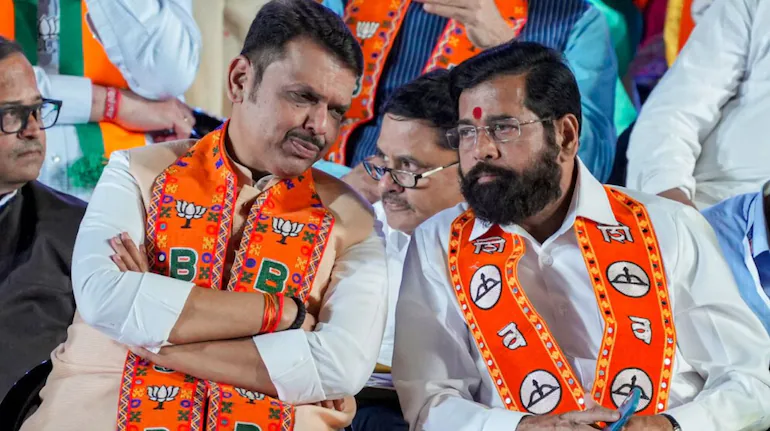
On one side stood the Mahayuti alliance, led by the Bharatiya Janata Party (BJP) and Eknath Shinde’s Shiv Sena faction. Backed by the state government under Chief Minister Devendra Fadnavis and aligned with the Centre, the alliance pitched the idea of “double-engine governance.” Its campaign highlighted infrastructure projects such as the Mumbai Coastal Road, metro expansion, road concretisation, slum rehabilitation schemes, and improved fiscal management. Stability, speed of execution, and access to state and central funds formed the core of its narrative.
Opposing them was the Thackeray-led front, comprising Shiv Sena (Uddhav Balasaheb Thackeray faction), the Maharashtra Navnirman Sena (MNS) under Raj Thackeray, and limited backing from the NCP (Sharad Pawar faction). This alliance leaned heavily on the traditional Shiv Sena plank of Marathi identity, the “Marathi Manoos,” and protection of Mumbai’s cultural and linguistic character. It accused the BJP-led government of favouring corporate interests and diluting the city’s regional ethos.
The campaign was intense and often personal, marked by sharp exchanges between the Thackeray cousins, emotive appeals to legacy, and debates over everyday civic issues — potholes, flooding, women’s safety, affordable housing, and waste management.
Other parties, including the Congress, smaller NCP factions, AIMIM, Vanchit Bahujan Aghadi, and independents, contested but failed to significantly alter the bipolar nature of the race.
Verdict Day: A Clear Shift in Power
Vote counting began at 10 AM on January 16, and early trends quickly signalled a decisive advantage for the Mahayuti alliance. By late evening, it was clear that the ruling front had crossed the halfway mark of 114 seats with room to spare.
As per trends and partial results available by the evening of January 16:
-
Mahayuti (BJP + Shinde Sena) secured approximately 125–130 or more seats.
-
The BJP emerged as the single-largest party with 87–93 seats, a significant rise from its 82 seats in 2017.

-
Eknath Shinde’s Shiv Sena contributed around 25–31 seats.
-
-
Shiv Sena (UBT) + MNS + allies together managed 65–75 seats, with UBT accounting for roughly 60–65 and MNS for 6–10.
-
Congress won between 13 and 22 seats, continuing its marginal presence in Mumbai’s civic politics.
-
Others, including AIMIM, independents, and NCP factions, filled the remaining seats.
The results revealed striking patterns. The BJP made inroads into areas long considered Shiv Sena bastions, including parts of Dadar, Dharavi, and several suburban wards. At the same time, UBT retained pockets of strength in areas like Worli, where it won six of seven seats, and a handful of former mayors and senior leaders held on to their wards.
Prominent winners included Rekha Ram Yadav of the Shinde Sena from Ward 1 and BJP’s Tejasvi Ghosalkar from Ward 2, while UBT maintained a presence in select eastern suburbs.
Reactions from the Political Spectrum
Prime Minister Narendra Modi thanked Mumbai’s voters, calling the mandate an endorsement of “good governance and development-oriented politics.” Chief Minister Devendra Fadnavis termed the outcome a “record-breaking mandate” that reflected public trust in infrastructure-led growth.
Uddhav Thackeray acknowledged the setback, conceding that the verdict was not in his alliance’s favour, while emphasizing that his party had retained important strongholds and would play a constructive opposition role in the civic body.
Why Mahayuti Won: An In-Depth Reading
Political analysts point to several factors behind Mahayuti’s decisive victory.
First, governance and development emerged as decisive issues. For many voters, particularly the urban middle class, visible infrastructure projects and alignment with state and central governments outweighed emotional or identity-based appeals.
Second, the erosion of traditional Shiv Sena bastions proved critical. The 2022 split in the Shiv Sena fractured its organisational base, allowing the BJP to penetrate neighbourhoods once considered impenetrable.
Third, opposition fragmentation weakened the challenge. Coordination issues between UBT and MNS, combined with Congress’s diminished urban footprint, prevented effective consolidation of anti-BJP votes.
Finally, the results mirrored a broader Maharashtra trend, where the Mahayuti alliance has dominated municipal corporations across the state, winning or leading in over 25 of 29 civic bodies.
What Lies Ahead for Mumbai
The implications of the 2026 BMC verdict are far-reaching. With control over the civic body, the Mahayuti alliance — and potentially a BJP mayor — will oversee one of the largest urban budgets in Asia. This strengthens the alliance’s political capital ahead of future state and national contests.
However, the mandate also brings immense responsibility. Mumbai’s new civic leadership faces chronic challenges: monsoon flooding, traffic congestion, housing shortages, pollution, waste management, and equitable urban development. How effectively the new BMC translates its electoral mandate into tangible improvements will determine whether this political shift becomes a lasting realignment or a temporary phase.
A City Signals Its Choice
In closing, the 2026 BMC elections did more than fill 227 wards; they closed a prolonged democratic gap and redrew Mumbai’s civic power map. By voting decisively for a development-focused, BJP-led alliance, Mumbai’s electorate signalled a preference for governance and stability over legacy politics.
As India’s financial capital looks ahead, all eyes are now on the new BMC — and whether it can deliver on the promise that carried it to power.